Tracing Your Pattern, Step by Step
When creating a garment, accuracy in transferring the pattern pieces is key. This ensures a perfect fit and an elegant drape. Whether you work freehand or with specialised tools, tracing your pattern is a fundamental skill where care and precision come together to preserve every detail of the design. Let’s explore how to approach this process with the attention it deserves for a flawless result.
✄ - - - - - - - - - - - - - - - - - - - - - - - - - - - - - - - - - - - - - - -- - - - - -
Transferring your Pattern
Ready-to-sew patterns are easy to cut out and uncomplicated to use. But remember: if you need a different size later, you’ve already cut the pattern apart and it cannot be used again. Although it might take a bit longer, in the long run it will pay to trace the pattern pieces. All you need is a pencil, white paper or tissue paper, tracing paper, and a tracing wheel.

Without Tracing Paper
Spread out the paper and place your pattern on top of it. Put weights on the pattern to prevent it from slipping. If you do not have any pattern weights, use canned goods, small hand weights, or something similar.
Now roll the tracing wheel along the lines you require. After you have traced all the pattern pieces, connect the dotted lines with a pencil until you have nice, continuous lines. If your pattern has curves, you can use a French curve to make your lines smooth.
With Tracing Paper
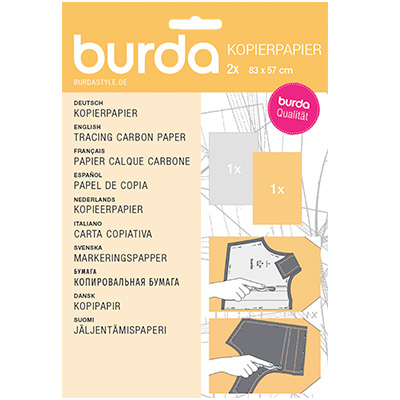
To immediately have nice, continuous lines, place the Burda tracing paper between the paper and the pattern piece. The coated side of the tracing paper must face the tissue paper. Insert the small disc into the tracing wheel and roll it along the pattern outlines. You can use a ruler to help you to make smooth straight lines.

Don't forget!
Copy all the markings and instructions onto your copied paper pattern. Check the pattern pieces you’ve copied against the pattern piece overview in the sewing instructions.
Our tips on how to easily trace a Burda pattern onto paper in this video tutorial:
With careful preparation and steady, precise movements, tracing your pattern becomes a true workshop ritual. By following every marking and line faithfully, you ensure your creation will fit beautifully and look as refined as the finest couture pieces. It's a subtle skill… yet an essential one.
And to find all the sewing basics and beginner-friendly patterns in one single book: